Logo of AISA - AI Fluency Assessment

AISA - AI Fluency Assessment

AI fluency for enterprise: Measure, Prove, Improve your organisation's AI skills

Visit aisa.to
10% off yearly purchase
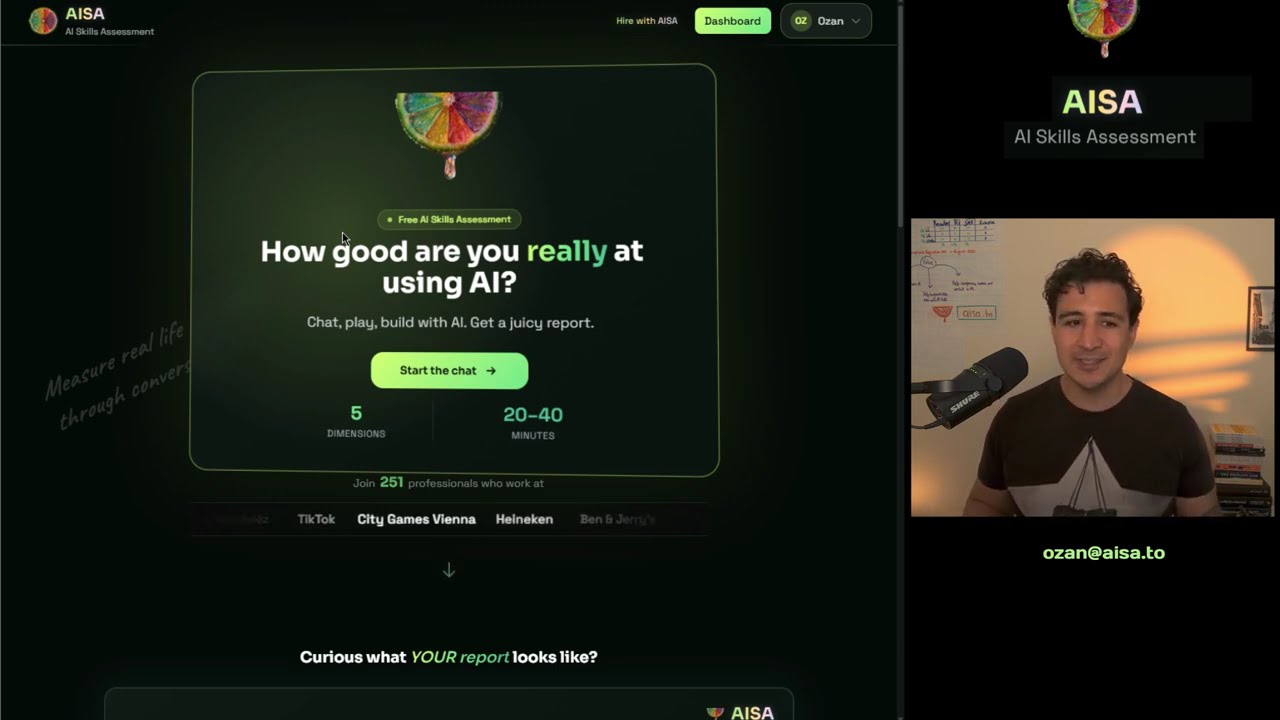
AISA - AI Fluency Assessment video preview

What AISA - AI Fluency Assessment does

AISA — AI fluency for enterprise
Measure, Prove, Improve your organisation's AI skills.

Your company has bought the AI tools and run the training. The question nobody can answer with evidence: did any of it work, and who can actually do the job? AISA is the measurement layer for workforce AI fluency — one standard, applied across every role, that turns "we think our team is getting good at AI" into a number you can act on.

Measure. Each person has a single structured conversation about their real work — their tools, their workflows, the problems they solve. AISA scores what they demonstrate, not what they claim, across five dimensions, and returns a calibrated score, a working-style persona, and a skill profile. Benchmark teams against industry peers, surface the AI champions already inside your organisation, and screen candidates on evidence instead of gut feel.

Prove. Every assessment is integrity-verified and held to the same standard, so you can compare across departments, roles and hiring rounds — then measure again after training to show the ROI of your AI investment in hard numbers. This is the measurement companies come back for.

Improve. The same profile points each person to their exact gaps, and AISA's AI Coach delivers daily micro-lessons tuned to what their report flagged — not a generic syllabus. Training goes where it's actually needed.

It all runs from one platform: employer dashboards, aggregate org-wide fluency scores, credit-based billing and bulk invitations make it practical at scale.

Why AISA, not a quiz or a course certificate. Most assessments test recall — define "hallucination," name three LLMs. AISA tests fluency. It adapts to each person's role and depth, uses interactive exercises that require live demonstration, and scores behavioural evidence rather than self-report. The result reflects how people actually work with AI. Built on the markers in Anthropic's 2026 AI Fluency research, and measuring dimensions beyond them.

The on-ramp is free. Any professional can take AISA free and walk away with a verified AI Fluency certificate to share on LinkedIn — which is how teams discover it and how your champions put their hand up. From there, bringing a whole workforce onto one benchmark is a single step.

Built for the organisations measuring AI capability at scale, and the knowledge workers, developers, designers, product managers, data scientists, marketers, HR and L&D leaders inside them.

Reviews

Used AISA - AI Fluency Assessment? Write the first review.

  • Ozan gets notified of your review and can reply.
  • A star rating is enough. A few words help even more.

Publisher

Ozan's avatar
Aisa
Is this your product? Claim it

Latest updates from AISA - AI Fluency Assessment

  1. AisaOzan Latest

    we crossed 1,928 assessments this week and finally had enough data to break down AI fluency by role cluster (our proxy for industry verticals).

    the thing that surprised me most: the biggest gap isn't between "tech people" and "everyone else." it's within tech itself.

    product teams average 54.9. engineering averages 54.6. founders lead at 55.1. all within a point of each other.

    but data analysts? 48.1. nearly dead average, despite working with data every day. turns out SQL and Python fluency doesn't automatically transfer to AI fluency. different skill, different muscle.

    the real outlier though is safety scores for designers — 35.7 average. lowest of any role on any dimension we measure. the people creating user-facing AI experiences are the least equipped to evaluate risks like bias and data privacy.

    full breakdown with dimension-level data for every role cluster: https://aisa.to/blog/how-ai-fluent-is-my-industry

    #buildinpublic #AISA

    2 0
  2. AisaOzan

    one of the more surprising patterns from our assessment data: the people who score highest on AI skills aren't the ones using the most tools. they're the ones who check whether the output is actually correct before using it.

    we track 11 criteria across 5 dimensions at aisa.to and 'critical evaluation' is the single biggest differentiator between someone who scores well and someone who doesn't. tool count, prompt complexity, years of experience — none of it predicts overall score as strongly as whether someone has a systematic verification process.

    building this into the scoring was one of the harder design decisions. most AI assessments weight knowledge and tool awareness heavily. but when you watch someone actually use AI, the gap between knowing about RAG and knowing when to distrust a confident-sounding answer is enormous.

    #builtinpublic #AISA

    2 0
  3. AisaOzan

    one thing nobody tells you about building an AI assessment tool: the hardest part isn't the AI. it's calibrating the scoring so it actually means something.

    we've run 2,000+ assessments at aisa.to and the most counterintuitive finding is that Safety consistently scores lowest (45/100 average). people are creative with AI, they can prompt well enough, but almost nobody has a systematic approach to verifying output or managing risk.

    building the scoring rubric for that dimension alone took us longer than building the entire conversation engine. turns out "did they check if the AI was right" has about 50 shades of grey.

    #builtinpublic #AISA

    3 0
  4. AisaOzan

    just crossed 694 product manager assessments on aisa.to and found something I genuinely didn't expect -- PMs are the most accurate self-assessors of any role we've tested.

    engineers consistently overestimate their AI skills, marketers tend to underestimate, but product managers? their self-reported skill level almost exactly matches their demonstrated performance in the assessment.

    my theory: PMs spend their entire job evaluating tradeoffs, scoping what's realistic, and calibrating confidence vs evidence. that muscle transfers directly to honest self-assessment.

    wrote up the full analysis with the data here: https://aisa.to/blog/product-managers-ai-skills-most-accurate-self-assessors

    #builtinpublic #AISA

    2 0
  5. AisaOzan

    one thing that keeps surprising me about building aisa.to: safety scores are consistently the lowest dimension. 45/100 average across all assessments.

    people can prompt well enough. they know which tools to use. but ask them about their process for handling bias, hallucinations, or data privacy when using AI with sensitive information — almost nobody has one.

    the gap isn't between AI users and non-users anymore. it's between people who have a systematic process for checking AI output and those who just eyeball it.

    if you're building anything in the AI skills space, safety is the dimension worth focusing on. biggest growth opportunity by far.

    aisa.to/state-of-ai-fluency

    #builtinpublic #AISA

    1 0
  6. AisaOzan

    crossed 1,200 assessments on aisa.to and the pattern that keeps getting sharper: the single best predictor of overall AI proficiency isn't how many tools someone uses or how creative their prompts are. it's whether they have a systematic process for checking AI output.

    we call this the verification gap. average score across all assessments is 48/100, 62% land below Proficient, and safety is the weakest dimension at 45/100. but the people who score in the top 20% almost always have one thing in common — they don't trust AI output by default, they verify it systematically.

    now building the coaching layer so people can actually close the gap, not just see it. knowing your score is step one, knowing what to do about it is where it gets interesting.

    aisa.to/state-of-ai-fluency

    #builtinpublic #AISA

    2 0
  7. AisaOzan

    hit 1,800 assessments on aisa.to this week. one thing that keeps surprising me in the data: the gap within teams is massive. we're seeing 82-point spreads between the highest and lowest scorer on the same team. same job title, same department, wildly different AI capability.

    makes you wonder how many companies are making AI strategy decisions based on their loudest voice rather than their most capable person.

    #builtinpublic #AISA

    0 0
  8. AisaOzan

    I've interviewed 1800 people about how they use AI, here are the findings.

    Well to be more precise, I built an agent that did that AND measured people's AI fluency (AISA) but you already know about that if you are following me. Anyways, here are the findings that amuse me.

    1. The least AI-fluent professionals overestimated their score by 40 points. The most fluent underestimated by 27. 67 point Dunning-Kruger gap.

    2. Product managers outscore engineers on AI fluency (59.2 vs 53.7). Applied judgement beats technical knowledge.

    3. HR people (ironically who make hiring decisions using AI) understand AI the least, with the lowest AI fluency score.

    4. People consistently say they are good with AI, but 2 out 3 fail to reach even proficient level.

    5. The average AI fluency score across 1,800 professionals is 48 — squarely in the Developing tier. Most people use AI regularly but without systematic practice.

    6. Company-wide AI training assumes everyone starts from the same place. The data says starting points vary by 5x within the same team.

    7. Same company, same tools, same training budget. The gap between the least and most AI-fluent employee in one team was 82 points (15 to 97).

    0 0
  9. AisaOzan

    crossed 1,000 assessments on aisa.to last month and one pattern keeps showing up — people who score highest aren't the ones using the most tools, they're the ones with a systematic process for checking whether AI output is actually correct.

    Safety and critical evaluation scored lowest across the board (45/100 avg). building out new coaching content focused specifically on verification workflows because it feels like the gap nobody's addressing.

    full data: aisa.to/state-of-ai-fluency

    #builtinpublic #AISA

    2 0
  10. AisaOzan

    week 2 of tracking where our aisa.to users come from and what surprised me: B2C is outpacing B2B by 3x. I built this as an enterprise hiring tool but individuals are signing up to benchmark themselves. the people who care most about their AI skills aren't the ones being told to learn — they're the ones who are already curious. rethinking our entire go-to-market based on this. #builtinpublic #AISA

    3 1
  11. AisaOzan

    interesting pattern from our latest AI skill assessments at aisa.to — the people who score highest aren't the ones using the most tools. they're the ones who've built a verification habit into their workflow. checking outputs against known sources, asking the model to argue against itself, running the same task through two tools and comparing. heavy users who skip verification consistently score 15-20 points lower despite using AI 3x more often. usage ≠ skill. #builtinpublic #AISA

    0 0

Questions about AISA - AI Fluency Assessment

AISA - AI Fluency Assessment is a business product listed on Uneed as a paid product. It's tagged with Learning, Project Management. Compare it against 3 alternatives to AISA - AI Fluency Assessment curated by the Uneed community.

What is AISA - AI Fluency Assessment?

AISA - AI Fluency Assessment is AI fluency for enterprise: Measure, Prove, Improve your organisation's AI skills.

Is AISA - AI Fluency Assessment free?

AISA - AI Fluency Assessment is a paid product. Check their website for current pricing.

What are the best alternatives to AISA - AI Fluency Assessment?

Top alternatives to AISA - AI Fluency Assessment include Taskade - AI Task List, Notes, Chat, Essense AI, LetsAsk AI. See all 3 curated alternatives on Uneed.

What category does AISA - AI Fluency Assessment belong to?

AISA - AI Fluency Assessment is listed under Business on Uneed.

Alternatives to AISA - AI Fluency Assessment

Compare alternatives